
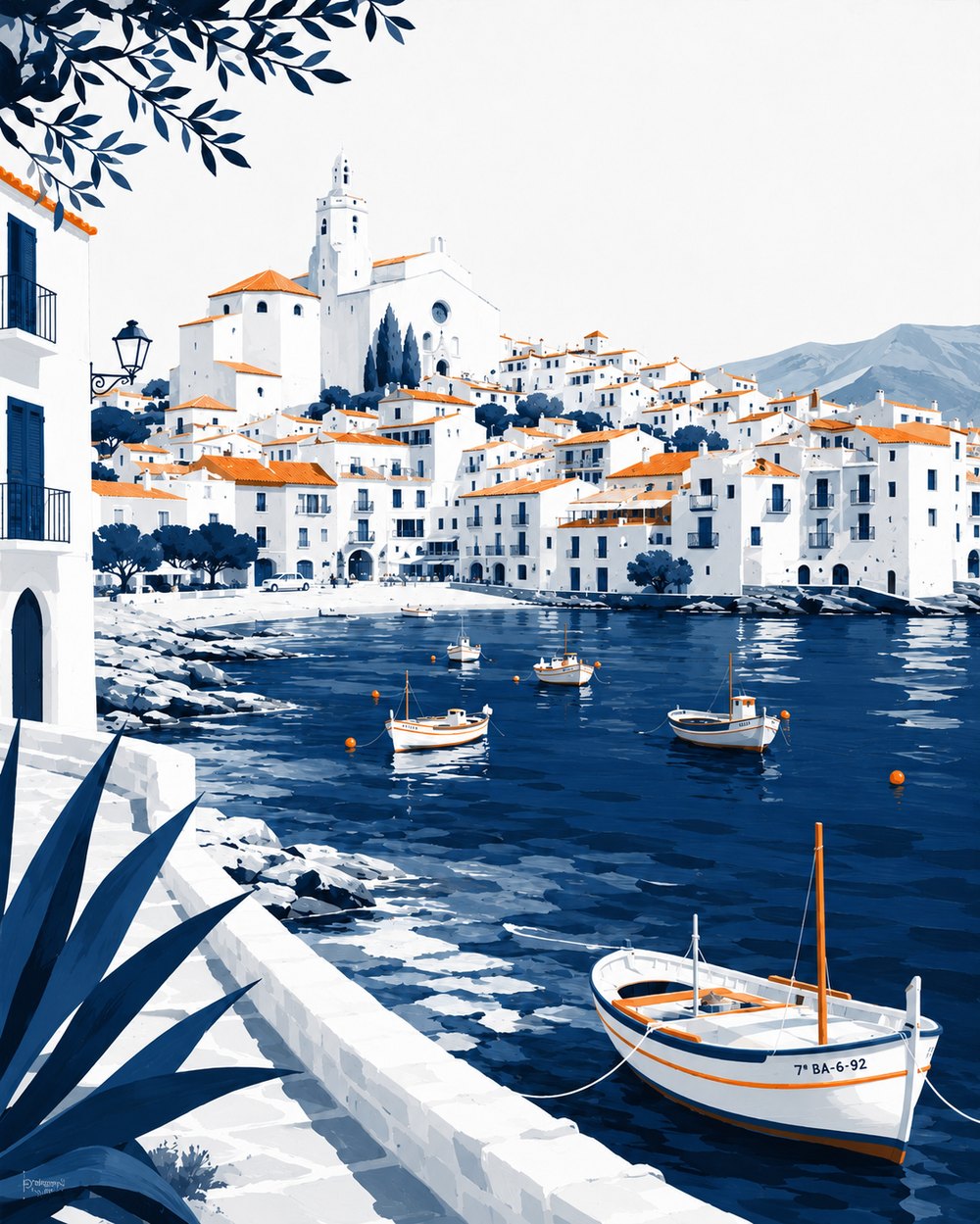
Understanding the legal framework of Cadaqués
Owning a property in Cadaqués is not the same as owning a property in an ordinary coastal town.
Cadaqués is part of a highly sensitive Mediterranean landscape, shaped by the sea, the Cap de Creus Natural Park, Portlligat, traditional architecture, dry-stone walls, a protected coastline and a very specific urban identity.
For this reason, property ownership in Cadaqués is influenced by several legal layers: the Spanish Coastal Law, the Cap de Creus Natural Park regulations, the PRUG of Cap de Creus and the new POUM of Cadaqués.
These rules are not simply restrictions. They are part of the reason why Cadaqués has preserved its value, its landscape and its identity.
Spanish Coastal Law in Cadaqués
The Spanish Coastal Law protects the public maritime-terrestrial domain — especially the seashore, beaches, coves, cliffs and coastal areas. Its purpose is to prevent the coastline from being privatised, closed, degraded or occupied without legal control. The law defines and protects the dominio público marítimo-terrestre and regulates its use, conservation and public access.
In Cadaqués, this is especially important because the relationship between the village and the sea is one of its main values. The bay, the small beaches, the coves, the paths by the water and the visual continuity between the white houses and the Mediterranean are part of what makes Cadaqués unique.
For property owners, the Coastal Law may affect houses, terraces, gardens, accesses, walls, swimming pools, extensions or works located near the sea.
What does the Coastal Law protect?
The Coastal Law mainly protects three legal areas.
First, the public maritime-terrestrial domain, which includes beaches, the seashore, certain cliffs, islets and other coastal spaces. These areas are public by nature and cannot be treated as ordinary private property.
Second, the protection easement zone, where private properties may exist but works, new constructions, extensions and changes of use may be subject to strict limits or prior authorisation.
Third, the transit easement, which generally protects a strip of land next to the sea for public pedestrian passage, surveillance and rescue purposes.
Why this matters in Cadaqués
In Cadaqués, the sea is not just a view. It is part of the public identity of the village.
The Coastal Law helps preserve the open relationship between private homes, public space and the Mediterranean. Without this protection, Cadaqués could easily lose one of the elements that makes property here so valuable: the possibility of living beside a coastline that remains visible, accessible and recognisable.
The Coastal Law is not only a limit on property. In Cadaqués, it is one of the legal reasons why the coastline still keeps its beauty, openness and long-term value.
Cap de Creus Natural Park regulations
Cadaqués is closely connected to the Cap de Creus Natural Park, one of the most exceptional landscapes in Catalonia. Law 4/1998 declares Cap de Creus and its marine environment a protected natural park. It also creates areas of more intensive protection, including natural sites of national interest and natural reserves.
The park includes territories of Cadaqués, El Port de la Selva, La Selva de Mar, Llançà, Palau-saverdera, Pau, Roses and Vilajuïga, as well as adjacent marine areas.
For Cadaqués, this protection is not secondary. The village is not simply near Cap de Creus — Cadaqués forms part of the cultural, visual and environmental logic of the park.
What does Cap de Creus protection cover?
The legal protection of Cap de Creus covers land, sea, geology, vegetation, wildlife, marine habitats, traditional landscapes, cultural heritage and visual identity. It includes several levels of protection:
Natural Park of Cap de Creus — the general protection framework for the terrestrial and marine landscape.
Natural Sites of National Interest — areas of higher landscape and environmental value, including zones such as Cap Gros–Cap de Creus, Punta Falconera–Cap Norfeu and Serra de Rodes.
Integral Natural Reserves — highly protected areas where conservation is especially strict because of their ecological fragility.
Partial Natural Reserves — areas that protect specific terrestrial or marine ecosystems, habitats and natural formations.
Why this matters for property owners
For a property owner in Cadaqués, Cap de Creus protection may be relevant when dealing with land, paths, vegetation, dry-stone walls, exterior works, rural plots, access roads, swimming pools, fencing, earthworks or landscape-sensitive areas.
It does not mean that nothing can be done. It means that each project must be reviewed carefully within its environmental and landscape context.
Cap de Creus is not an obstacle to Cadaqués. It is one of the reasons why Cadaqués remains exceptional.
PRUG of Cap de Creus
The PRUG is the Pla Rector d'Ús i Gestió (management and use plan) of the Cap de Creus Natural Park. If the law creates and protects the park, the PRUG explains how the park is used and managed in practice.
The new PRUG was approved by Order TER/130/2025, of 23 July, and applies to the Natural Park of Cap de Creus, its natural sites of national interest, integral natural reserves and partial natural reserves.
The PRUG regulates real activities that affect daily life in Cadaqués: navigation, anchoring, fishing, diving, recreational activities, guided visits, scientific research, environmental education and conservation.
What does the PRUG regulate?
The PRUG regulates how people use the park, especially in sensitive land and marine areas. It may affect navigation, anchoring, recreational boating, fishing, diving, kayak routes, access to protected areas, organised activities, environmental visits, scientific uses and conservation measures.
In the marine area, the PRUG is especially important because Cap de Creus is not only a beautiful coastline — it is also a fragile marine ecosystem.
Why this matters in Cadaqués
Cadaqués has a direct relationship with the sea and with Cap de Creus. Many ordinary activities — going out by boat, visiting coves, anchoring, fishing, diving or enjoying the coastline — take place within a protected environment. The PRUG seeks to make these uses compatible with conservation.
For owners, residents and regular visitors, this is important because the quality of life in Cadaqués depends not only on the houses, but also on the condition of the sea, the coves, the paths, the silence and the natural landscape.
The PRUG protects the intelligent use of Cap de Creus, so the park can remain part of everyday life in Cadaqués without losing its natural value.
The new POUM of Cadaqués
The POUM of Cadaqués is the municipal urban planning document that defines how the village can grow, transform and protect its territory.
The Town Council of Cadaqués initially approved the new POUM on 18 September 2025 and opened it to public information. The official municipal page still identifies this stage as Aprovació Inicial POUM 2025.
The new POUM updates the previous urban planning framework, which came from the 1986 PGOU. Its purpose is to adapt Cadaqués to current challenges: housing, landscape protection, tourism pressure, mobility, environmental sensitivity, urban quality and long-term territorial balance.
What does the POUM regulate?
The POUM regulates key aspects of property and urban development in Cadaqués. It defines land classification, permitted uses, building conditions, urban density, protected areas, public facilities, mobility systems, parking, housing policies, landscape protection and the relationship between the urban centre, Portlligat, the coastline and the natural surroundings.
For property owners, the POUM is essential because it can affect the future of a house or plot. It may influence buying, selling, renovating, extending, regularising works, dividing property, changing use, applying for licences, checking planning status or assessing the future value of a property.
Why this matters for foreign property owners
Foreign owners often look first at the title deed, the land registry or the cadastral description. In Cadaqués, that is not enough.
Before buying, selling, inheriting, renting or renovating a property, it is advisable to review the urban planning status of the property, the applicable POUM rules, the existing licences, possible coastal or environmental restrictions and any mismatch between the legal description and the physical reality of the property.
The POUM is not just a technical planning document. In Cadaqués, it is the legal tool that determines how the village can evolve without losing its identity.
Why these rules matter together
The legal framework of Cadaqués cannot be understood through one single rule.
The Coastal Law protects the relationship between the village and the sea. The Cap de Creus regulations protect the natural and cultural landscape around Cadaqués. The PRUG regulates the practical use of the protected park and its marine environment. The POUM defines how the municipality can grow, preserve its character and manage property development.
Together, these rules explain why Cadaqués remains different from other Mediterranean destinations. They protect the coastline, the natural park, the village, the landscape, the housing model, the cultural memory and the long-term value of owning property here.
For international property owners, this legal framework may seem complex. But properly understood, it is also a guarantee. It protects what makes Cadaqués irreplaceable.
What legal rules affect property owners in Cadaqués?
Property owners in Cadaqués may be affected by four main legal frameworks: the Spanish Coastal Law, the Cap de Creus Natural Park regulations, the PRUG of Cap de Creus and the municipal POUM of Cadaqués. These rules protect the coastline, the natural park, the marine environment, the landscape and the urban identity of the village. They may affect buying, selling, renovating, extending, inheriting, renting or regularising a property in Cadaqués.